


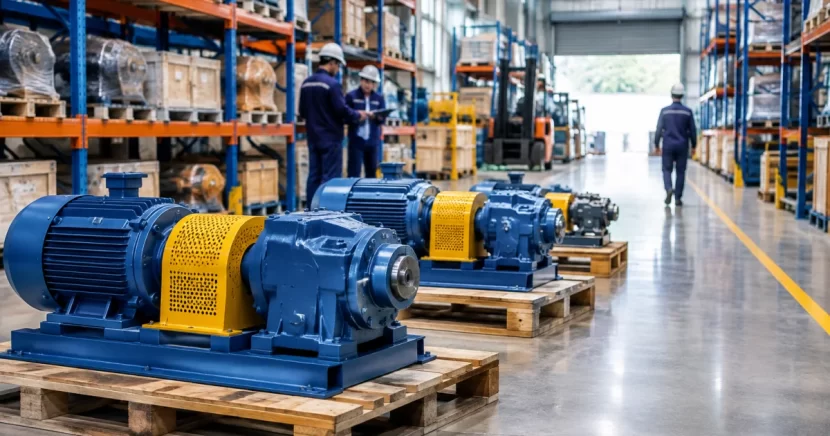
Across Malaysia’s manufacturing base, the way factories and machine builders buy geared drives is changing. Instead of selecting a motor and gearbox separately, many teams now evaluate a gear motor package as a system: the geared motor plus mounting (foot/flange/base/torque arm), output interface alignment (coupling/pulley), protection accessories, braking/backstop options, cable entry/terminal box orientation, and the documentation needed to install, maintain, and audit the line.
That shift shows up in day-to-day sourcing: OEM engineers want repeatable, standardised packages they can reuse across machine variants; maintenance teams want true drop-in replacements that reduce downtime and site rework; production and reliability teams want predictable starting behaviour, thermal margin, and protection against overloads and misalignment. In this environment, specifying and stocking a geared motor is less about “a motor size” and more about “a complete drive arrangement.”
This article outlines the practical demand shifts affecting geared motor packages in Malaysia manufacturing and what OEMs and maintenance teams can do now. You’ll also see why small specification gaps (like mounting orientation or output interface) can turn a simple replacement into a multi-day retrofit unless they’re captured in the package definition.
Why gear motor packages are being treated as systems (not parts)
A geared motor rarely fails or succeeds in isolation. Reliability depends on how the drive integrates with the driven machine, how it is installed, and how it is maintained. As factories push for faster changeovers, higher OEE targets, and fewer unplanned stops, teams are recognising that the “package” determines installation time and risk.
For buyers searching for Gear Motor Malaysia solutions, expectations have expanded: suppliers are increasingly asked to support selection based on duty cycle, starting method, shock loads, service factor, and installation constraints—not only kW and ratio. Packages don’t need to be fully custom, but they do need clear boundaries: what is standard, what is configurable, and what requires engineering review.
Package-level elements that most often drive outcomes include:
- Mechanical interface readiness: output shaft type (solid/hollow), keyway and tolerances, shrink disc suitability, flange/foot patterns, torque arm/base details, and space envelope.
- Installation constraints: mounting position (horizontal/vertical), lubrication suitability, breather/drain locations, and inspection accessibility.
- Electrical integration: terminal box orientation, cable glands/entries, earthing, encoder or brake wiring, and compatibility with VFDs/soft starters.
- Protection & safety: brake motors, backstops, guarding expectations, and controlled stopping for vertical or high-inertia loads.
- Start-up behaviour: soft-start requirements and load protection, including when a fluid coupling is appropriate for shock reduction.
Define these early and procurement can compare like-for-like, OEMs can reuse designs, and maintenance can stock fewer—but more correct—spares.
Demand shift #1: Standardisation pressure—yet more configuration options
OEMs and maintenance teams both want fewer variants: fewer motor frames, fewer gear unit sizes, fewer special parts. At the same time, lines are diversifying (more SKUs, more formats, more flexible automation), which can require different speeds, torques, mounting styles, and control features. The practical answer is often “standard core, configurable edges.”
- Standard cores: a short list of preferred gearmotor families (for example helical bevel or helical worm), a controlled set of motor ratings, and default mounting arrangements.
- Configurable edges: ratio within defined bounds, output bore/shaft details, torque arms, brake selection, terminal box position, and accessories aligned to site standards.
Practical example (OEM platforming): A conveyor OEM standardises on two gearmotor families—one for light/medium conveyors and one for heavier inclines—then defines a small set of package codes (gear unit + motor rating + mounting + output interface). For variants, they adjust ratio and add braking/backstop options within pre-approved limits. Maintenance benefits because spares can be redeployed between similar lines.
What to prepare: Build a “preferred package list” with boundaries. Clearly label what can change without re-qualification (for example ratio in a range, terminal box direction, encoder add-on) versus what triggers review (mounting changes, hollow-to-solid shaft changes, brake addition, higher inertia, or different stopping behaviour).
Demand shift #2: Faster installation and replacement—drop-in expectations
In many plants, the major cost is not the geared motor price; it’s downtime, labour, and the risk that the replacement doesn’t align with the baseplate, coupling, or driven shaft. That’s pushing demand toward packages designed for rapid changeouts.
Drop-in expectations typically focus on:
- Mounting interchangeability: consistent foot/flange patterns and shaft height alignment.
- Output repeatability: same shaft or hollow-bore diameter, locking method, shaft length/projection, key size, and tolerances.
- Service access: space to open the terminal box, reach wiring, and check oil level or service points.
- Consistent direction and settings: especially where VFD parameters are tied to a motor/gear combination.
Practical example (maintenance reality): A site holds a spare “same kW and ratio,” but the output shaft is longer and the terminal box faces a guard. The unit fits, but the guard must come off, the cable route changes, and the coupling spacing is reworked—turning a 2-hour job into a full shift. If the package definition included shaft projection and terminal box orientation, the spare would have been a true drop-in.
What to prepare: Document “critical-to-fit” dimensions and installation constraints in the package spec. For multi-line sites, standardise terminal box direction, cable entry method, and mounting position wherever practical.
Demand shift #3: More VFD-driven applications—and more attention to motor suitability
VFDs are common in conveyors, mixers, dosing systems, and many process lines because they enable speed control and smoother operation. But VFD operation changes what matters in a gearmotor package:
- Thermal margin at low speed: reduced fan cooling can raise temperature unless the motor is correctly rated/sized or has forced ventilation.
- Torque requirements across the speed range: constant torque vs variable torque profiles affect motor and ratio selection.
- Insulation and electrical robustness: drive switching can stress insulation; correct specification and installation reduce risk.
- Gearbox efficiency and heating: especially at higher ratios or continuous duty.
These factors shift selection from “any motor will do” to “the motor must match the control strategy.” In Malaysia, buyers may start with a broad search such as Electric Motor Malaysia when the real need is a package that handles controlled speed and duty cycle without overheating or nuisance trips.
Actionable selection tip: When requesting a quotation, include speed range, duty cycle, ambient conditions, and whether control is DOL/VFD/soft starter. If available, include acceleration time, start frequency, and torque limits so the supplier can recommend a combination that performs across the real operating envelope, not only at nominal speed.
Demand shift #4: More emphasis on helical, bevel, worm, and “best-fit” gear geometry
“Gear motor” covers multiple gear geometries, and demand shifts are increasingly about choosing the best fit for the machine family. Different lines prioritise different outcomes: efficiency, compactness, right-angle layout, backdriving behaviour, noise, and shock robustness.
A practical evaluation view:
- Helical gear arrangements: often selected for efficiency and smooth running in conveyor and process applications.
- Helical bevel geared motors: suited to right-angle layouts with good efficiency and robust torque capacity—common in heavy-duty conveyors, lifts, and material handling where space and shaft orientation matter.
- Helical worm geared motors: chosen where compact right-angle layout is important; suitability depends on duty cycle, efficiency expectations, and thermal limits.
For OEMs, the question is not “which is best in general,” but “which is best for this platform and duty cycle.”
Useful next reads: If you are comparing right-angle options for heavier duty cycles, review helical bevel geared motors and how they are commonly configured for industrial installations.
Demand shift #5: Integrated braking, holding, and safer stopping
As plants focus more on safety and controlled stopping, brake motors and braking options are being defined earlier—especially for:
- Incline/decline conveyors where rollback must be prevented.
- Hoists, lifts, and vertical axes where holding is required when power is off.
- Indexing/positioning sections where overshoot creates jams or quality issues.
From a package standpoint, the brake isn’t a last-minute add-on. It affects wiring, control logic, heat dissipation, and maintenance access—and it changes what “equivalent replacement” means.
Practical example (spec mismatch): A conveyor was supplied with a brake motor to prevent run-on. Later, maintenance replaces it with a non-brake motor of the same kW and speed. The conveyor coasts longer and causes downstream accumulation issues. Electrically similar, functionally different—preventable if the package spec captured stopping requirements.
What to prepare: State the brake purpose (emergency stop, holding, anti-coast, positioning) and include brake voltage type (AC/DC) and rectifier approach (external or integrated). Label spares clearly “with brake” vs “without brake,” including terminal box and brake wiring differences.
Demand shift #6: Smoother starts and drivetrain protection—more interest in couplings and soft-start behaviour
Many premature failures and nuisance trips are driven by starting shock, high inertia, frequent starts, or jams—not by the gearmotor alone. That’s increasing attention on “in-between” components (couplings) and start-up strategy as part of the package.
For high-inertia loads (large fans, crushers, heavy conveyors, or equipment starting under load), smoother starts can protect gear teeth and bearings, motor shafts/keys, and belts/chains and driven equipment from peak torque spikes.
Solutions may include VFD ramps, soft starters, or hydraulic fluid couplings. In Malaysia, many buyers look specifically for Transfluid solutions when the goal is controlled start-up and drivetrain protection in harsh duty cycles.
Actionable evaluation questions:
- What is the start frequency per hour, and does the load start fully loaded?
- Is the load high inertia, and do you see belt slip, chain shock, or gearbox noise at start?
- Are you trying to reduce electrical inrush and mechanical shock at the same time?
If repeated start stress is present, treat start-up strategy (and coupling selection) as part of the gear motor package—not a separate project added after commissioning problems appear.
How OEMs can adapt: specify packages that scale across machine variants
OEMs in Malaysia often need to deliver customised machines while controlling engineering time and part variation. A package strategy creates reusable building blocks without overcomplicating design.
1) Build a package datasheet template
For each machine family/module, maintain a one-page package definition covering:
- Application description (conveyor, mixer, feeder, elevator, etc.)
- Duty cycle, start frequency, ambient, and control method (DOL/VFD/soft starter)
- Required output speed range and torque requirement (or load details)
- Gear type preference (helical/helical bevel/helical worm), mounting position, and service access constraints
- Output interface details (shaft/hollow bore, keyway, flange) plus torque arm/base needs
- Brake/backstop requirements and the functional reason for each
- Electrical details (voltage/frequency, IE class if required), terminal box orientation, and cable entry preferences
This reduces ambiguity during quotation and makes packages repeatable for production and future spares.
2) Design for interchangeability where it matters
To enable drop-in spares across variants, standardise on a small number of interfaces (shaft sizes, flanges, mounting holes). Avoid “almost the same” interfaces that force site rework. Often, a slightly larger standard package is easier to support than many near-duplicates.
3) Protect commissioning schedules by clarifying lead-time drivers
Configuration complexity can affect availability and documentation. The more unique the package (special shaft, non-standard mounting, brake/encoder options, special coating), the more important it is to confirm build description, documentation, and acceptance criteria. Ask suppliers to write configurations in a repeatable way so maintenance can reorder the same package later.
How maintenance teams can adapt: spares strategy and fit-for-purpose replacements
Maintenance is often expected to reduce inventory while also reducing downtime. The workable approach is to stock smarter: fewer spares, but spares that match package-critical details and can be redeployed across similar assets.
1) Separate emergency spares from planned overhaul spares
Emergency spares must be true drop-in and functionally equivalent. If machining, rewiring, or control changes are required, it’s not an emergency spare—it’s a project. Planned overhauls can allow engineered changes (for example terminal box direction or gear type upgrades) as long as they are documented.
2) Capture nameplate and gearbox details—then add missing package details
Nameplates rarely capture the full package. In your asset register, add:
- Mounting position and lubrication notes
- Output interface dimensions (shaft length/keyway or hollow-bore) and coupling type
- Terminal box direction and cable entry method
- Brake presence and brake wiring arrangement
- Accessories/guards that affect service access
This enables faster, more accurate purchasing decisions during breakdowns—especially when the buyer is not the person who installed the original machine.
3) Decide when “equivalent” is not equivalent
“Equivalent” replacements most commonly fail in three ways:
- Mechanical gap: interface differences prevent reuse of coupling/pulley/base.
- Functional gap: braking/backstop behaviour changes safety or process control.
- Thermal gap: motor is fine at nominal speed but overheats at low speed under VFD control.
When any of these apply, treat the replacement as an engineering change, not a like-for-like spare.
Choosing suppliers and product families: what to compare during evaluation
For commercial evaluation, compare suppliers on package fit and lifecycle practicality—not only brand preference. When comparing geared motor packages for Malaysia manufacturing, ask for clear answers on:
Package configurability and repeatability
- Can the supplier provide consistent configuration codes/build descriptions so you can reorder the same package later?
- Can you specify mounting, output interface, brake, and electrical orientation without ambiguity?
Coverage across applications
- Does the product family cover helical, right-angle, and heavy-duty needs with consistent interfaces?
- Can the supplier support conveyors, material handling, processing lines, and general machinery through one relationship?
Support for drivetrain protection components
- Can the supplier support couplings and controlled start-up solutions when shock reduction is required?
- Is selection guidance available for high inertia or frequent starts?
Spare-part and maintenance alignment
- Can you align spares to a small number of standard packages?
- Can the supplier suggest interchangeable alternatives when older builds are no longer preferred?
If your plant uses multiple drive components, a power transmission specialist can help evaluate the full system (motor, gearbox, coupling) rather than optimising only one component category.
Related product families worth comparing (for standard package building blocks)
When building a short list, it often helps to review geared motor families by application fit rather than individual SKUs. For example:
- For robust right-angle drives, review Helical Bevel Geared Motors as a building block for conveyors and heavy-duty layouts.
- For compact right-angle solutions, review Helical Worm Geared Motors and evaluate thermal/duty-cycle fit.
- For standardising by brand family (spares and documentation consistency), browse categories such as Rossi gear motor categories or TPL gear motor categories.
- For certain reducer styles, consider whether options like cyclo gear reducer families match your torque, shock, and maintenance preferences.
The goal is to identify a small set of package-capable families you can standardise around and support long-term.
Conclusion: prepare now with clearer package definitions and smarter spares
Malaysia manufacturing’s demand shift for gear motor packages is driven by operational reality: downtime is expensive, installation time matters, and “close enough” replacements create avoidable risk. OEMs and maintenance teams that define packages as systems—mechanical interface, mounting, electrical orientation, braking/holding behaviour, and start-up protection—tend to achieve faster commissioning, simpler spares strategies, and fewer surprises during breakdowns.
If you’re planning your next purchase, start by documenting package-critical details for two or three common applications (for example conveyors, mixers, and feeders). Then build a preferred package list with controlled configurability. That step alone typically improves OEM design reuse and maintenance response time without forcing every application into a fully custom build.
Frequently Asked Questions
What information should I provide when requesting a geared motor package quotation?
Provide the application type, required output speed/torque (or load details), duty cycle, start frequency, control method (DOL/VFD/soft starter), mounting position, output interface (shaft or hollow bore details), terminal box orientation, and any brake/backstop requirement with the reason (holding, anti-coast, positioning).
How do I avoid buying a “same kW and ratio” replacement that doesn’t fit?
Treat fit as a package issue, not a nameplate issue. Confirm the mounting arrangement, shaft/hollow-bore dimensions, shaft projection, flange/foot pattern, terminal box direction, and any accessories (torque arm, guards, brake wiring). Record these in your asset register so future replacements are truly drop-in.
When should an OEM standardise gear motor packages instead of customising every machine?
Standardise when you build multiple variants of the same machine family, when customers demand faster delivery, or when maintenance needs interchangeable spares. Use a “standard core, configurable edges” approach: keep a small set of preferred gearmotor families and interfaces, then vary ratio, orientation, and options within defined limits.
Are VFD-driven applications different when selecting a geared motor package?
Yes. VFD operation can change cooling at low speed, torque demands across the speed range, and electrical/thermal stress. Include the speed range, duty cycle, and acceleration requirements in your specification so the motor and gearbox are selected for real operating conditions, not only nominal speed.
When is a brake motor necessary in a geared motor package?
Brake motors are commonly specified when you need controlled stopping or holding—such as incline/decline conveyors to prevent rollback, vertical axes (hoists/lifts) that must hold load when power is off, or process sections where coasting causes jams or quality issues. Document the stopping/holding function so replacements remain functionally equivalent.
Need help standardising gear motor packages for your plant or OEM builds?
Cetrade (M) Sdn Bhd is a Malaysia-based power transmission specialist in Penang supplying electric motors, gear motors, gear reducers, brake motors, vibrator motors, and Transfluid couplings—covering brands such as Rossi, ZAE Muller, AEB, Amdell, TPL and Transfluid.
If you’re evaluating standard vs customised geared motor packages, share your application details and constraints. Our team can help you compare suitable configurations, define package-critical fit details for drop-in replacements, and align a practical spares strategy for maintenance.
Disclaimer
We hope you find this article helpful and informative. Our content is intended for general informational purposes only and should not be considered as professional advice or a comprehensive representation of all services offered by Cetrade (M) Sdn. Bhd.
For personalized advice, please consult with a professional or contact us directly. While we strive for accuracy and completeness in our blog posts, we cannot guarantee they are error-free. Cetrade (M) Sdn. Bhd. assumes no responsibility for any errors or omissions.