


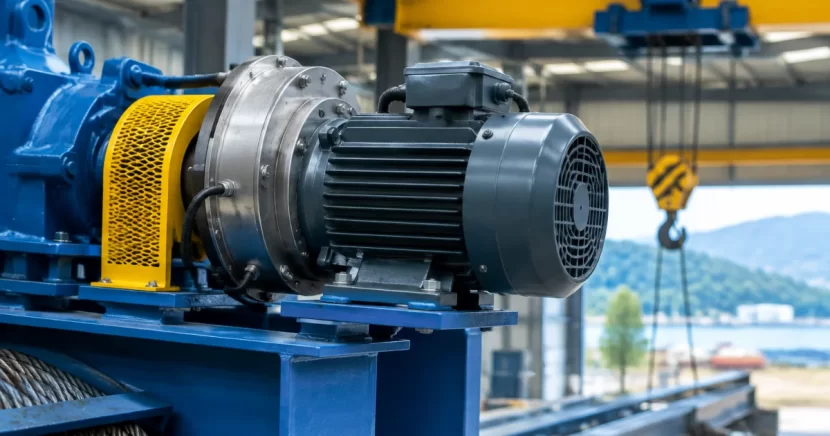
When a hoist trolley stops above a work area, or a crane bridge must hold position without drift, the braking system is a safety function—not just a convenience. Choosing the right Brake Motor Malaysia buyers look for should start with braking needs (how you stop and how you hold), then move to motor sizing and mounting.
This beginner guide is for material handling operators, OEMs, and maintenance teams selecting a new or replacement brake motor for hoists, cranes, and conveyors. It covers the main brake types, what each is best for, and what to prepare before requesting a quotation.
What a brake motor does (in simple terms)
A brake motor is an electric motor with a brake unit fitted to it—usually on the non-drive end. When power is removed (or the brake coil is de-energised), the brake engages to stop the motor shaft and hold it from turning. Most industrial designs are fail-safe: a power loss makes the brake engage automatically.
For lifting and conveying, separate two functions that are often confused:
- Stopping: bringing a moving load to a controlled stop within an acceptable time/distance.
- Holding: preventing creep or rollback when motion is not commanded (suspended loads, incline conveyors).
Selection starts by deciding whether the brake is mainly for holding, mainly for stopping, or both. Many conveyors rely on drive control (VFD braking) for routine stopping and use the brake mainly for holding/parking, while hoists typically require a strong holding brake as a primary safety measure.
Brake types you will meet: AC brake vs DC brake (and what that really means)
In Malaysia, brake motors commonly use either AC brake coils or DC brake coils. The friction mechanism is usually similar (spring-applied, electrically released), but coil power and control differ—affecting response and consistency.
AC brake motors: simple wiring, common for general duty
An AC brake uses an AC coil and is often straightforward to wire. It suits many general industrial drives where very fast brake response is not critical.
Typical fit: packaging conveyors, light-duty transfer lines, and general machinery needing a parking brake function and acceptable stopping performance.
DC brake motors: faster response and more consistent release
A DC brake uses a DC coil, usually with a rectifier (built-in or external) converting AC supply to DC. DC brakes are often chosen for quicker, more predictable release/engagement—useful for safety-critical holding and frequent start/stop.
Typical fit: hoists and cranes, indexing/positioning conveyors, and applications needing tighter stop/hold control.
Important: brake “type” is also about how you control it
Two sites can use the same brake motor model but get different results depending on the drive and brake timing:
- Direct-on-line (DOL): the brake releases when the motor is energised; simple but less adjustable.
- VFD-controlled: the motor can ramp down smoothly while the brake engages at a set speed/time to reduce shock. Too early causes harsh stops and wear; too late can cause drift or overrun.
For replacements, tell the supplier whether the motor is DOL or VFD driven, and whether the brake coil supply comes from mains or a dedicated control circuit.
Application-focused selection: hoists, cranes, and conveyors
Use the application to prioritise brake torque, response, and control coordination. The points below help you specify the right direction when sourcing.
Hoists: prioritise holding and safe load control
Hoists handle gravity loads, so holding torque is critical. The brake must hold the suspended load (with a safety factor) reliably over the duty cycle.
- Prioritise: fail-safe holding, adequate brake torque, thermal capacity for repeated stops, and controlled engagement to reduce shock.
- Common approach: DC brake for consistent response; coordinate with a VFD (if used) so the brake engages at low speed.
- If underspecified: load creep, brake overheating, accelerated lining wear, and unsafe stopping distances.
If a gearbox is used (for example, helical or helical-bevel), remember the brake is typically on the motor shaft, not the drum. Required brake torque must account for gear ratio, efficiency, and whether the system can backdrive.
Cranes: smooth stopping and anti-drift behaviour
Overhead cranes have multiple motions (hoist, cross travel, long travel) and each axis can have different braking needs. Travel motions often prioritise smooth stopping to reduce swing; hoisting prioritises secure holding.
- Travel motions: brake motor often acts as a parking brake and emergency support, while the VFD handles routine deceleration.
- Hoist motion: treat like a hoist—holding torque and response are key.
- Maintenance note: check alignment and coupling condition; vibration and misalignment shorten brake life.
Because crane systems are safety-critical, match brake voltage, wiring scheme, and release method to the existing panel to avoid unintended behaviour.
Conveyors: decide whether you need stopping, holding, or both
Many conveyors need a brake mainly for holding (prevent rollback on an incline) or parking (maintenance safety). Some heavy-load or bulk-handling conveyors also use the brake to reduce run-on.
- Flat conveyors: often a parking brake is enough; stopping is handled by the drive control.
- Inclined conveyors: holding torque matters; confirm whether the gearbox can be backdriven.
- High-inertia conveyors: if the brake is used for frequent stopping, thermal capacity and wear become important.
If you’re deciding between a brake motor and a separate braking arrangement, review the full drivetrain (gearbox type/ratio, coupling, and start/stop control). In heavy-duty lines, a soft-start solution such as a hydraulic coupling can reduce shock loads at start, while the brake focuses on holding and controlled stops.
Key specifications to collect before you buy (replacement or new build)
To speed up selection and avoid returns, prepare the details below. Even one missing item (such as brake coil voltage) can delay procurement.
1) Motor electrical basics
- Power (kW/HP) and speed (pole count or rpm)
- Supply voltage and frequency (for example 415V 3-phase)
- Duty (S1 continuous or intermittent duty for hoists)
- Starting method: DOL, star-delta, or VFD
Many teams comparing Electric Motor Malaysia options focus on electrical compatibility first. For brake motors, you must match both the motor and the brake circuit details.
2) Mechanical fit: mounting, shaft, and dimensions
- Frame size and mounting (B3 foot, B5 flange, B14, etc.)
- Shaft diameter, keyway size, and shaft length
- Space constraints (the brake unit adds length)
For gearmotor assemblies, confirm how the motor mates to the gearbox. If you use geared solutions (helical gear motors or helical bevel geared motors), the motor interface can be as important as kW.
3) Brake specs: torque, coil voltage, and rectifier
- Brake torque (Nm) required for holding and/or stopping
- Brake coil voltage (AC or DC) and whether a rectifier is built-in
- Manual release requirement (maintenance/emergency movement)
- Stop frequency (stops per hour) and load inertia (if known)
More torque is not always better. Oversizing can cause harsh engagement, shock loads, and faster wear on couplings, gearboxes, and brake linings. Target the correct torque with an appropriate safety factor.
4) Environment and protection
- Conditions: dust, humidity, washdown, outdoor exposure, or high heat
- Required ingress protection (IP rating) and corrosion considerations
- Special needs: marine coating, food-area rules, chemical exposure
In industries such as palm oil, quarry, or chemical handling, contamination and heat can accelerate lining wear and reduce braking performance. Selection and inspection planning should go together.
A beginner-friendly decision checklist (use this before requesting a quote)
- Define the job: holding, stopping, or emergency stop backup?
- Confirm load behaviour: backdriving risk, incline, suspended load, high inertia?
- Choose control style: DOL or VFD, and desired stop feel (smooth vs quick).
- Pick brake coil approach: AC for simpler general use; DC for faster/consistent response and better control integration.
- Match mechanical interface: frame size, mounting, shaft, and gearbox adaptor (if applicable).
- Verify brake circuit: coil voltage, rectifier location, and wiring diagram compatibility.
- Plan maintenance: manual release need and access for air-gap/lining inspection.
If you’re upgrading the drivetrain (not just replacing a motor), a different gearmotor arrangement (for example, a helical gear reducer) may reduce shock and improve stopping behaviour. Suppliers that cover motors, gear reducers, and couplings can help validate system compatibility.
Common mistakes when choosing a brake motor (and how to avoid them)
- Only matching kW and frame size: also match brake torque and brake coil voltage.
- Ignoring stop frequency: frequent stops generate heat; specify duty and stops per hour where possible.
- Assuming the VFD replaces the brake: VFD braking slows the motor but may not provide fail-safe holding during power loss or faults.
- Overlooking gearbox backdriving: gear type/ratio affects holding requirements.
- Not checking clearance: the brake adds length; ensure space for the brake housing and fan cover.
Conclusion: specify the brake function first, then the motor
For hoists, cranes, and conveyors, the right brake motor stops and holds predictably, fits the mechanical envelope, and matches your control wiring. Start by clarifying whether you need holding, stopping, or both; choose AC or DC coil based on response and control needs; then confirm brake torque, mounting, and environmental details.
If you share your application, load behaviour, control method, and existing nameplate/wiring information, a specialist supplier can recommend a brake motor option that improves safety and reduces downtime without overcomplicating the selection.
Related product pages (useful when comparing options)
- AC brake motor product options
- DC brake motor product options
- Helical gear motors (for geared drive assemblies)
- Helical bevel geared motors (for heavier duty loads)
Frequently Asked Questions
Should I choose an AC brake motor or a DC brake motor for a hoist?
For many hoists, DC brakes are preferred because the brake release and engagement can be faster and more consistent, which helps with controlled holding and frequent start/stop. However, the best choice depends on your control method (DOL or VFD), required holding torque, and the brake coil/rectifier arrangement your panel supports.
What information do I need to replace a brake motor quickly?
Bring the motor nameplate details (kW/HP, voltage, speed/poles, frame size), mounting type (B3/B5/B14), shaft size, and brake details (brake torque rating if available, brake coil voltage AC/DC, and whether a rectifier is built-in or external). Also note whether the motor is run DOL or with a VFD.
Can a VFD replace the need for a brake on conveyors or cranes?
A VFD can provide smooth deceleration and dynamic braking, but it may not provide a fail-safe holding function when power is removed. If you must prevent rollback on an incline, hold position during power loss, or meet safety expectations for suspended loads, a mechanical brake is still important.
How do I know if my conveyor needs a holding brake torque upgrade?
If the conveyor is inclined, carries heavy loads, or shows rollback/creep when stopped, you may need higher holding torque or a different control sequence (brake timing with the VFD). Also check whether the gearbox can be backdriven under load, because that increases the demand on the brake.
Why does brake coil voltage and rectifier type matter during replacement?
If the brake coil voltage or rectifier arrangement does not match your existing control panel, the brake may not release properly, may overheat, or may engage unpredictably. Always confirm whether the brake coil is AC or DC, the rated coil voltage, and where the rectifier is installed (motor terminal box or control panel).
Need help selecting a brake motor for your hoist, crane, or conveyor?
Cetrade (M) Sdn Bhd is a Malaysia-based power transmission specialist supplying AC and DC brake motors, electric motors, geared motors, gear reducers, and related drive components. Share your application (hoist/crane/conveyor), control method (DOL or VFD), and existing motor/brake details, and our team can help you shortlist a suitable brake type, torque range, and mounting to reduce downtime and improve safety.
Disclaimer
We hope you find this article helpful and informative. Our content is intended for general informational purposes only and should not be considered as professional advice or a comprehensive representation of all services offered by Cetrade (M) Sdn. Bhd.
For personalized advice, please consult with a professional or contact us directly. While we strive for accuracy and completeness in our blog posts, we cannot guarantee they are error-free. Cetrade (M) Sdn. Bhd. assumes no responsibility for any errors or omissions.