


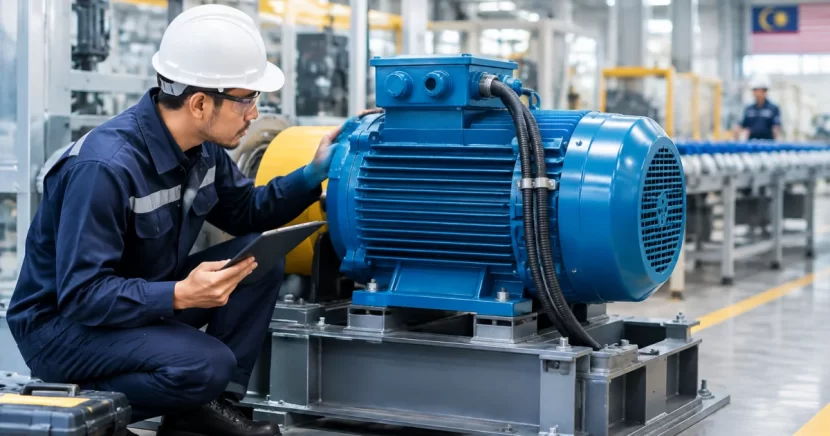
Across Malaysian factories, motor decisions are increasingly treated as a reliability-and-energy strategy, not a simple maintenance purchase. Engineers are checking efficiency at real operating loads, validating duty cycles, and confirming frame/mounting/shaft details before approving a replacement. Procurement teams, meanwhile, are standardising models and reducing downtime risk when a critical drive fails.
This is especially visible in Electric Motor Malaysia buying discussions: suppliers are expected to support a complete replacement plan—speed/torque requirements, gearbox compatibility, starting/stopping behaviour, terminal box orientation, spares strategy, and commissioning checks. For sites running mixed applications (conveyors, pumps, fans, mixers, crushers, packaging), a one-size-fits-all approach often costs more over the lifecycle than it saves upfront.
Below are the key 2026 themes factories are raising, what those questions mean technically, and how to turn them into a practical replacement cycle that fits Malaysian operating realities (shift patterns, maintenance windows, stocking practices, and retrofit constraints).
1) Efficiency priorities are shifting from “rated IE” to “system efficiency”
Most teams already know efficiency classes matter. What’s changing is that discussions are moving beyond “Is it IE2/IE3?” toward performance at the actual duty point and the losses around the motor. Engineers are increasingly asking:
- What is efficiency at the real loading point (not only at full load)?
- Will higher efficiency change thermal behaviour in a hot plant environment?
- Will gearbox/coupling/belts/chains erase motor efficiency gains?
- Is oversizing “for safety” increasing energy use and heat?
In practice, factories want to avoid paying for a premium motor while leaving bigger losses untouched—worn gearboxes, poor alignment, slipping belts, restricted ventilation, or processes that run throttled most of the time.
Practical example: conveyor line with frequent partial load
If product flow varies and a conveyor runs lightly loaded for much of the shift, the best rated class may not deliver the best outcome if the process is controlled via mechanical restrictions or frequent stop-start. Plants may see more benefit from right-sizing, improving the gearbox selection, choosing a coupling that reduces shock loads, or using a start/drive strategy that matches the process profile.
Key takeaway: suppliers are being asked to discuss application profile and drive-train losses—not just a catalogue page.
2) Replacement cycles are becoming planned events, not emergency reactions
Plants are increasingly mapping motors into “critical spares,” “planned replacements,” and “run-to-failure” units to reduce procurement surprises. That drives structured supplier questions such as:
- Which frame sizes/power ratings should we standardise across the plant?
- What are realistic lead times for the ratings we use most?
- Which motors should we keep as shelf spares?
- Can we keep mounting and shaft dimensions to avoid baseplate rework?
A planned approach typically starts with a motor register (tag, location, kW/HP, rpm/poles, frame, mounting, voltage, enclosure, duty/ambient, driven equipment, and gearbox ratio if geared) plus a simple risk score tied to production impact.
What’s driving this trend in 2026?
- Downtime cost visibility: production losses are tracked more tightly, so “cheap” motors that extend downtime are harder to justify.
- Maintenance window pressure: shorter shutdowns mean replacements must fit first time with minimal modification.
- More automation: tighter speed/torque requirements and more sensors/controls expose poor motor/drive behaviour faster.
- Parts consolidation: fewer SKUs and more interchangeability reduce stocking and restart delays.
3) Procurement is asking for interchangeability details upfront (frame, mounting, shaft, terminal box)
One of the most common questions now is: “Can we drop this motor into the same footprint without rework?” That pushes evaluation beyond kW/HP and rpm into mechanical compatibility. Factories ask suppliers to confirm:
- Frame size and dimensions: foot hole spacing, shaft height, overall length.
- Mounting arrangement: foot, flange, or combined.
- Shaft details: diameter, key size/keyway, shaft length, any special tolerances.
- Terminal box orientation/cable entry: can glands/conduit routes stay unchanged?
- Rotation and clearance: especially where space/guards are fixed.
For maintenance teams, the real “efficiency” is completing a changeover inside the planned window. A higher rating doesn’t compensate for a half-day of fabrication because the new motor doesn’t match the base or the terminal box interferes with cable routing.
4) Gear motor and gearbox pairing decisions are under tighter scrutiny
Many “motor problems” are selection or gearbox problems: overheating from load mismatch, seal failures from misalignment, or shock loads from aggressive start/stop. In 2026, factories expect suppliers to validate the complete drive train—especially on conveyors, agitators, and hoists where a gear motor malaysia approach is common.
Expect questions like:
- Do we need helical, bevel, worm, or shaft-mounted reducers for this load profile?
- What service factor suits frequent starts, reversing, or shock loads?
- Is the ratio delivering the right operating speed at the machine shaft?
- Would an integrated gear motor package improve interchangeability versus separate motor + gearbox?
Why “helical” keeps coming up
Helical designs are often selected for smoother transmission and load sharing in continuous duty. Plants increasingly want the choice justified by torque, duty cycle, and operating hours—not only by legacy installs. For more on reducer selection, see Why Helical Bevel Gear Reducers Are Ideal For Heavy Duty Applications In Malaysia.
Practical example: “same kW” but different gearbox ratio
Two motors with the same rating can behave very differently if the gearbox ratio changes or torque demand is misunderstood. A conveyor that overloads at the tail end may not need “more motor”; it may need a better ratio, stronger gearbox stage, improved tensioning, or a soft-start approach to reduce peak torque and chain shock.
5) Starting and stopping behaviour is becoming a key selection criterion
Plants are paying renewed attention to what happens during start and stop to reduce mechanical stress, nuisance tripping, and process upsets (spillage, belt slip, water hammer). Factories are asking about:
- High-inertia loads: fans, blowers, large conveyors, mixers needing higher starting torque.
- Frequent starts: indexing/packaging duties that start-stop all day.
- Holding requirements: hoists, lifts, vertical conveyors that must stop and hold safely.
- Process stability: controlled acceleration/deceleration to protect equipment and product flow.
Where brake motors fit
Brake motors are commonly used for controlled stopping and holding. The 2026 shift is toward specifying braking torque, switching method, and thermal capacity based on real duty cycles—rather than adding a brake as a default.
Where hydraulic couplings fit (Transfluid)
For shock loads, difficult starts, or high inertia, plants are revisiting fluid couplings to smooth start-up and protect the drive train. In Malaysia, discussions often include whether a Transfluid coupling approach could reduce peak stresses and extend life on conveyors, crushers, and other demanding drives. If you see repeated coupling/key failures or gearbox input damage, a smoother-start strategy may address root causes better than repeated like-for-like coupling swaps.
6) Motor condition monitoring is being simplified for maintenance teams
Not every site will implement advanced analytics, but many are standardising simple, repeatable checks to predict failures and schedule work:
- Temperature trending: bearing housing and stator temperatures under similar load.
- Vibration checks: routine measurements to flag misalignment, looseness, imbalance, bearing wear.
- Electrical checks: insulation resistance during shutdowns; current balance during operation.
- Visual inspection: fan/vent condition, corrosion, terminal tightness, cable strain.
Suppliers are increasingly asked what to record at commissioning so future comparisons are meaningful. A basic baseline—load current, surface temperatures, defined vibration measurement locations, and terminal box wiring photos—often speeds troubleshooting later.
Practical example: the “hot motor” that isn’t overloaded
A motor can run hot with acceptable current if ventilation is compromised (blocked fins, poor airflow, hot enclosure) or if bearings are failing and friction increases. Misalignment can also shift loads into the bearing set. Plants increasingly value suppliers who diagnose these factors instead of immediately upsizing.
7) Special applications are asking for clearer, application-based specifications
Malaysia’s industries (palm oil, food processing, quarry, chemical, general manufacturing) often use similar motor families but need different “must-have” details. Factories are asking suppliers to state suitability in application terms, including:
- Washdown or dusty zones: sealing, enclosure type, maintenance access.
- High ambient temperatures: thermal class and derating considerations.
- Variable duty: intermittent vs continuous duty and what that implies for selection.
- Integration constraints: mounting direction, limited access, keeping cabling unchanged.
Vibrator motors: more emphasis on voltage flexibility and correct sizing
Facilities are also asking more about vibrator motor selection—especially for equipment moved between plants, exported, or retrofitted. Key topics include voltage/frequency compatibility, sizing for required force/output on hoppers/screens/feeders, and how mounting affects performance and bearing life. See How To Choose The Right Vibrator Motor In Malaysia For Your Industrial Application.
8) What factories are asking suppliers in 2026 (and how to answer well)
To make these trends actionable, here are common supplier questions and what a strong answer typically includes.
Question A: “Can you recommend an efficient replacement without changing our machine?”
A strong response confirms drop-in mechanical fit (frame/mounting/shaft), electrical compatibility (voltage/frequency, starting method), and expected performance at the actual duty point. It should also flag likely site issues early—cooling clearance, cable routing, gearbox input speed limits—so there are no surprises at installation.
Question B: “Should we replace just the motor or the motor + gearbox package?”
A good answer considers the full drive train. If the gearbox shows rising noise, high temperature, oil leaks, or backlash, a motor-only swap may simply shift the failure point. For some lines, gear motor packages improve alignment consistency and simplify spares; for others, keeping a separate gearbox preserves ratios and mounting constraints. For background, see Common Gear Motor Malaysia.
Question C: “What should we keep as critical spares?”
Critical spares are usually motors that stop the line, have long lead times, and are hard to substitute due to special mounting, brake requirements, special shafts, or difficult access. Many plants also standardise bearings, terminal accessories, and coupling elements because small parts can delay a restart as much as the motor itself.
Question D: “Can you support brand and model continuity?”
Some teams prioritise continuity to reduce variation and keep documentation consistent; others accept alternatives if interchangeability and performance are proven. Where installed-base preferences exist, suppliers may be asked for like-for-like options or acceptable equivalents (for example, maintaining frame/performance when sourcing AEB motor options). Product ranges can be reviewed via AEB electric motor options or Amdell electric motor options.
Question E: “We’re seeing repeated failures—what information do you need to diagnose?”
Factories expect evidence-based troubleshooting: load type, starts/hour, ambient temperature, coupling type, alignment method, installation photos, any vibration/temperature history, and clear failure modes (bearing, winding, shaft/key/coupling). This discipline reduces repeated “trial replacements.”
How to turn these trends into a practical motor replacement plan
Trends matter only if they lead to consistent decisions. Here is a straightforward workflow many plants use.
Step 1: Build a motor list that’s actually usable
Start with verified nameplate and site checks. Minimum fields that save time later include: kW/HP, voltage, frequency, poles/rpm, frame, mounting, enclosure, duty cycle clues, gearbox ratio (if geared), coupling type, and constraints (space, terminal box direction).
Step 2: Sort by production risk and interchangeability
- Critical and unique: special mounting/brake/shaft or hard-to-access locations.
- Common and interchangeable: standard frames/ratings used across machines.
- Non-critical: redundancy exists or downtime impact is low.
Standardising common motors typically delivers fast gains: fewer spares, faster changeovers, and simpler purchasing.
Step 3: Decide the replacement trigger, not just the replacement date
Instead of “replace every X years,” define triggers that fit your reality: insulation resistance below your threshold, repeated bearing work, chronic overheating, or unacceptable vibration. Tie actions to planned shutdowns.
Step 4: Confirm the drive-train—gearbox and coupling selection
Where gearboxes are involved, validate ratio, output torque, service factor, and mounting before ordering. Where couplings fail, examine alignment, soft foot, base rigidity, and start-up shock. In some cases, a smoother start strategy (including fluid couplings for difficult starts) provides more value than repeated component swaps.
Step 5: Create an RFQ template that forces clarity
To reduce wrong deliveries, include:
- Nameplate and installation photos
- Frame/mounting requirements and shaft dimensions
- Voltage/frequency and start/control method (DOL, soft starter, drive)
- Duty details (starts per hour, run hours/day, load variability)
- Environment notes (dust, washdown, heat)
- Target delivery timeline and any spares required with the motor
Conclusion: what to expect from motor suppliers—and what to ask back
The core Electric Motor Malaysia trend in 2026 is that factories are no longer satisfied with “same kW, same rpm.” They want suppliers who confirm interchangeability, discuss efficiency at real operating points, and support replacement cycles that reduce downtime risk. They also expect tighter alignment between the motor and the rest of the drive train—gearboxes, couplings, braking, and start-up behaviour.
If you’re planning upgrades or standardising spares, document your most common frames/ratings, identify critical unique units, and engage a supplier who can support both technical selection and practical availability. For geared solutions, you can also explore Rossi gear motors or TPL gear motors to compare configuration options for conveyors and material handling drives.
Frequently Asked Questions
How many times can we rewind or repair a motor before replacement makes more sense?
It depends on the motor’s criticality, the cause of failure, and whether the repair restores reliability and efficiency for your duty cycle. In practice, many factories switch to replacement when failures become repetitive (for example, recurring bearing damage from alignment issues or repeated winding faults), when lead time risk is too high, or when mechanical interchangeability lets you standardise spares. A good approach is to define internal triggers—such as repeated repairs within a short period, unacceptable vibration/temperature trends after repair, or insulation test results that keep degrading—so the decision is consistent rather than reactive.
What information should we provide a supplier to get the right AC motor replacement in Malaysia?
Provide a clear photo of the nameplate plus installation details: kW/HP, voltage, frequency, rpm/poles, frame size, mounting type (foot/flange), shaft diameter and key details, terminal box orientation/cable entry constraints, and enclosure/environment notes (dust, washdown, heat). Also include application details such as load type (fan, pump, conveyor), start frequency, and whether you use direct-on-line, soft starter, or a drive. These details help the supplier confirm both electrical suitability and drop-in mechanical fit.
When should we choose a gear motor package instead of a separate motor and gearbox?
A gear motor package is often preferred when you want simpler alignment, easier interchangeability, and fewer part numbers—especially for common conveyors or standardised drives. A separate motor and gearbox can be better when you must keep an existing reducer mounting, have a fixed ratio you cannot change, or need flexibility to swap only one component. The best choice depends on duty cycle, torque requirements, available installation space, and your spare-parts strategy.
How can a fluid coupling help with difficult starts, and is it relevant for Transfluid coupling Malaysia enquiries?
A fluid coupling can smooth acceleration by limiting peak torque and reducing shock loads transmitted into couplings, keys, gearboxes, and driven equipment. This can be helpful for high-inertia loads, loaded conveyors, crushers, and applications where direct starts create belt slip, nuisance trips, or mechanical damage. For Transfluid coupling Malaysia enquiries specifically, the key is to share the application profile (inertia, start method, starts per hour, load characteristics) so the coupling type and sizing match your operating reality rather than being selected by power rating alone.
Do electric vibrating motors support multiple voltages for construction, mining, and food processing applications?
Some vibrator motors are available in variants that suit different voltage and frequency combinations, but it is not universal across all models. For construction and mining environments, ruggedness and correct force output are often the priority; for food processing, consistency, installation method, and maintenance access can matter more. Always confirm the exact voltage/frequency required, the desired vibration force/output for the equipment (hopper, feeder, screen), mounting orientation, and expected duty cycle so the supplier can recommend a suitable model rather than assuming one motor fits every application.
Plan your next motor replacement with Cetrade (M) Sdn Bhd
If you’re mapping a replacement cycle, standardising spares, or troubleshooting repeated motor/gearbox failures, Cetrade (M) Sdn Bhd can help you shortlist practical options for your application. As a Malaysia-based power transmission specialist, we support electric motors, gear motors, gear reducers (including helical arrangements), brake motors, vibrator motors, and Transfluid couplings—so you can evaluate the full drive train, not just the motor nameplate.
Share your nameplate details, installation photos, duty cycle, and any constraints (mounting, shaft, terminal box direction, start/stop frequency). We’ll help you identify configurations that fit your machine footprint and operational priorities.
Disclaimer
We hope you find this article helpful and informative. Our content is intended for general informational purposes only and should not be considered as professional advice or a comprehensive representation of all services offered by Cetrade (M) Sdn. Bhd.
For personalized advice, please consult with a professional or contact us directly. While we strive for accuracy and completeness in our blog posts, we cannot guarantee they are error-free. Cetrade (M) Sdn. Bhd. assumes no responsibility for any errors or omissions.