


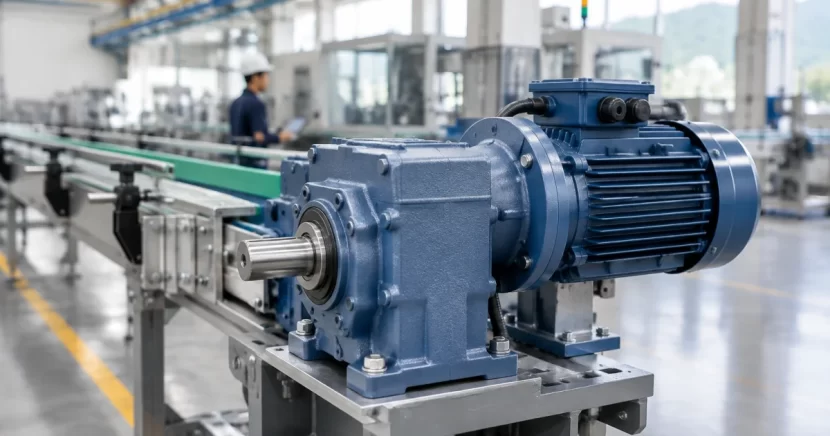
Sourcing a right-angle gearbox for a conveyor, mixer, or packaging line sounds simple—until the mounting doesn’t match, the output speed is wrong, or a “like-for-like” replacement uses a different shaft standard. The best place to buy a Helical Bevel Gear Reducer Malaysia isn’t defined by the lowest quote, but by who can confirm your specification fast, document it clearly, and support the install when site constraints show up.
This guide is for maintenance teams and engineering contractors in Malaysia who want fewer RFQ cycles, less rework, and more predictable lead times. It separates what you must specify (fact) from how to choose and manage a distributor (opinion) so you get the right unit the first time.
What “where to buy” should mean for a helical bevel reducer
Fact: A helical bevel gear reducer is a right-angle gearbox (often 90°) using helical and bevel stages to reduce speed and increase torque. Fit and lifespan depend on interfaces (shafts/bores, flanges/feet) and operating conditions (duty, loads, temperature, contamination, washdown).
Opinion: In Malaysia, the “right place to buy” is typically a distributor/importer who can: (1) finalize the exact configuration, (2) give realistic delivery expectations for that exact variant, and (3) support motor matching, couplings, and mounting accessories. If you buy “just a gearbox” without confirming motor frame/interface, output connection, and service factor, you’re shifting risk to installation day.
Also avoid assuming different reducer families are interchangeable. A parallel shaft reducer may match ratio but not envelope, shaft position, or mounting—so verify right-angle options early if space is fixed.
Spec checklist: what to confirm before you request a quote
Use this checklist to create a clean RFQ. The goal is to remove guesswork. A nameplate photo, output-connection close-up, and a few key measurements can drastically speed up selection.
1) Required output: torque, speed, and ratio
- Output speed (rpm): required speed at the driven shaft.
- Gear ratio: provide ratio, or provide input and output speed so it can be calculated.
- Torque (Nm): required output torque, or load data (conveyor load/chain pull, drum diameter, mixer viscosity notes) so torque can be estimated.
Fact: Ratio alone is not enough—reducers with the same ratio can have very different torque and thermal capacities.
2) Motor details (if you want a complete motor-gear package)
- Motor type: standard AC, inverter duty, brake motor, or servo integration needs.
- Power (kW/HP), voltage, frequency: especially if motor supply is in scope.
- Speed / poles: base speed affects ratio selection (e.g., 2-pole vs 4-pole).
- Mounting and frame size: IEC frame and mounting orientation for fit and direct mounting.
Opinion: Even if you’re buying reducer-only, share the motor nameplate and frame details. It prevents mismatched input flanges/shafts and helps a distributor propose a geared-motor option when it reduces installation work.
3) Output interface: solid shaft, hollow shaft, keyway, or shrink disc
- Output type: solid output shaft or hollow bore.
- Dimensions: shaft diameter, key size, hollow bore diameter, and any tolerance requirements.
- Connection method: keyed, splined, shrink disc, torque arm, or flange coupling.
Fact: Many “direct replacements” fail here. Small differences in shaft/key dimensions can turn a quick swap into fabrication and downtime.
4) Mounting, orientation, and space constraints
- Mounting style: foot mount, flange mount, or both.
- Shaft position: right-angle direction and whether left-hand/right-hand orientation matters.
- Installation position: horizontal/vertical mounting can affect lubrication and breather/oil plug positions.
- Envelope limits: max height/width and any interference (guards, trays, beams).
Opinion: Send a simple sketch or marked photo with “no-go zones,” plus maintenance access needs (oil plugs, breather, motor fan clearance, removal path).
5) Duty cycle, starts per hour, and shock loading
- Operating hours: continuous or intermittent.
- Start/stop profile: starts per hour, reversing, indexing, frequent jogging.
- Shock loads: jams, surges, mixer slugs, belt slip events.
Fact: Service factor selection often determines reliability. If you have shock or frequent starts, state it so sizing includes appropriate margin.
6) Environment: temperature, washdown, dust, and corrosion
- Ambient temperature range.
- Contaminants: dust, abrasive fines, chemical vapors, oil mist.
- Washdown: water jets/chemicals and whether seal upgrades are needed.
Opinion: In food, chemical, or palm oil-related environments, treat sealing and coating as core specs. It’s usually cheaper than early bearing/seal failures.
Lead time questions that save weeks (and awkward shutdowns)
Lead time is driven by configuration and dependencies, not a generic model number. Your goal is to learn what’s stocked locally, what’s built-to-order, and what changes if specs shift midstream.
- Is this exact configuration stocked in Malaysia, or imported on demand? Ask by size/ratio range and mounting type.
- What is the “long pole” item? Often special output shafts, non-standard hollow bores, or certain motor frames.
- Is the motor included—and is it in stock? Reducer availability doesn’t guarantee the matching motor (frame/voltage/duty) is available.
- What is the technical approval timeline? Confirm drawing/datasheet confirmation and who must sign off.
- Can you offer an interim workaround? Example: close ratio plus VFD adjustment, or a compatible alternative mounting for urgent downtime.
- What documentation ships with it? Installation guidance, lubrication notes, and mounting-position instructions.
Opinion: Don’t accept “available” without “available in what configuration.” A distributor who asks clarifying questions early is usually reducing your risk, not slowing you down.
What to ask a distributor (beyond price) to avoid mis-spec
If you only ask for a quote, you’ll often get a quote. If you ask for confirmation and trade-offs, you’re more likely to get a unit that installs cleanly and lasts.
Ask for a confirmation sheet, not only a part number
Fact: Part numbers can be ambiguous across brands or series revisions. A confirmation sheet that lists ratio, rated torque, mounting, shaft/bores, lubrication, and motor interface reduces ordering errors.
Opinion: Make it standard: no PO until you have a one-page technical summary attached to procurement records. It also makes future replacements faster.
Ask about equivalents and trade-offs (helical bevel vs other reducers)
Alternatives (parallel shaft, shaft-mounted, different housing) can reduce cost or lead time, but only if interfaces and duty match.
- If we switch reducer type, what changes in mounting and shaft interface?
- Will it meet the same service factor and thermal performance?
- Do we need additional parts (torque arm, adapter flange, coupling)?
Opinion: Accept alternatives only with a clear site-impact list. If trade-offs can’t be explained plainly, keep comparing suppliers.
Ask how the distributor handles application support
- Selection support: can they confirm sizing from your process data?
- Commissioning realities: alignment guidance, backstop needs (if relevant), brake motor selection for holding loads.
- Spare parts strategy: what to stock (seals, breather, oil, couplings) for critical lines.
Fact: Even a correctly selected reducer can fail early if misaligned or if duty is underestimated.
My buying process recommendation for Malaysia plants and contractors
This opinionated process is designed for MOFU buyers comparing suppliers and trying to reduce surprises.
Step 1: Decide whether you want a reducer-only swap or a full drive package
If the existing motor is old, mismatched, or has unknown history, a geared motor (motor + reducer matched) can cut installation time and compatibility risk—often worth the small capex difference on conveyors and packaging lines.
Step 2: Provide three artifacts in your RFQ email
- Photos: nameplate(s), overall installed view, and close-up of the output connection.
- Measurements: shaft diameter/key, bolt patterns, any center heights, and space limits.
- Operating notes: duty cycle, starts/hour, product type, and recent failure symptoms (overheating, seal leak, broken key).
Opinion: The fastest way to reduce lead time is removing assumptions. A single output-shaft photo can prevent a week of wrong proposals.
Step 3: Ask for two options (standard and best-fit)
Request a standard option (typical spec, usually lower cost) and a best-fit option (better sealing, higher service factor, or easier mounting). This anchors the decision on lifecycle risk, not just price.
Step 4: Confirm logistics and after-sales expectations
Confirm packaging, pre-delivery checks, and what support is available if site conditions differ (shaft wear, misalignment, non-standard coupling).
Recommended product pages and related guides (useful while you compare)
- Helical Bevel Gear Reducers (right-angle helical bevel options)
- Helical Bevel Geared Motors (matched motor-gear packages)
- Helical Gear Reducer (inline options)
- Right Angle Shaft Gear Reducers (compare right-angle families and mounts)
- Helical Bevel Gear (selection context)
Opinion: Comparing multiple reducer families—regardless of brand—helps you catch common spec traps early, especially around mounting position and output connection style.
Conclusion: buy the distributor’s process, not only the gearbox
Fact: The right helical bevel reducer selection depends on confirming ratio, torque, motor interface, mounting, shaft/bore details, duty, and environment. Missing any item can cause delays, retrofits, or early failure.
Opinion: In Malaysia, better outcomes usually come from distributors who ask detailed questions, document the configuration, and support compatible motors, couplings, and accessories. If someone rushes to quote without clarifying basics, you’re not saving time—you’re moving the cost to installation day.
Use the checklist, send stronger RFQ inputs, and insist on a confirmation sheet. That approach shortens selection cycles and reduces the risk of ordering the wrong right-angle reducer for your line.
Frequently Asked Questions
What information should I provide to quote a helical bevel gear reducer accurately?
Provide required output speed (rpm), estimated output torque (or load details), desired ratio, mounting style (foot/flange), installation orientation, output shaft or hollow bore dimensions (including keyway), motor nameplate details (kW, poles, frame, voltage), duty cycle/starts per hour, and environmental conditions such as washdown, dust, or corrosion.
Is a helical bevel gear reducer interchangeable with a parallel shaft gear reducer?
Not usually. They can achieve similar ratios, but the geometry, mounting footprint, shaft positions, and right-angle vs inline layout differ. You may be able to substitute only if you confirm space constraints, output interface, torque rating, service factor, and any required accessories (adapters, torque arms, couplings).
How can I reduce lead time when buying gear reducers in Malaysia?
Send clear photos and measurements with your RFQ, confirm whether the exact configuration is stocked locally or imported, and ask which components drive the longest lead time (special shafts, non-standard flanges, or motor frame/voltage). Also confirm the technical approval timeline so selection and documentation don’t stall the order.
Should I buy a reducer only, or a complete geared motor package?
If your existing motor is in good condition and interfaces match, a reducer-only purchase can work. If the motor condition is unknown, the motor frame/flange is hard to match, or you want faster installation with fewer compatibility risks, a geared motor package (motor + reducer matched) is often the simpler and more reliable approach.
What should I ask a distributor before issuing a purchase order?
Ask for a written configuration summary (ratio, torque rating, mounting, shaft/hollow bore details, lubrication notes for your mounting position), confirmation of motor interface compatibility, realistic delivery expectations for that exact variant, and what support is available if site dimensions or loads differ from assumptions.
Need help selecting the right helical bevel reducer for your line?
Cetrade (M) Sdn Bhd is a Malaysia-based power transmission specialist in Penang supplying electric motors, gear motors, gear reducers, brake motors, vibrator motors, and hydraulic couplings. If you share your current gearbox photos, shaft details, and operating conditions, our team can help you shortlist suitable helical bevel configurations, confirm motor interface compatibility, and prepare a clear specification for procurement.
Disclaimer
We hope you find this article helpful and informative. Our content is intended for general informational purposes only and should not be considered as professional advice or a comprehensive representation of all services offered by Cetrade (M) Sdn. Bhd.
For personalized advice, please consult with a professional or contact us directly. While we strive for accuracy and completeness in our blog posts, we cannot guarantee they are error-free. Cetrade (M) Sdn. Bhd. assumes no responsibility for any errors or omissions.