


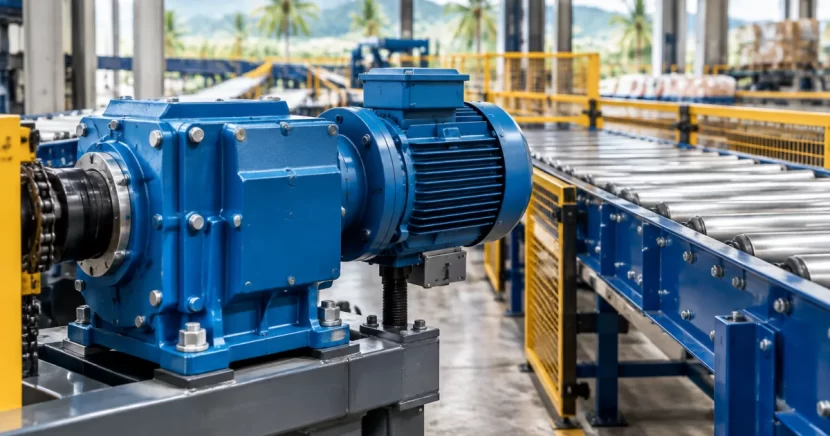
Walk through Malaysian factories—conveyors in warehouses, mixers in food lines, crushers in quarries, transfer stations in palm oil mills—and a pattern shows up fast: when a drive must run long hours with minimal fuss, teams often default to a helical gearbox or helical geared motor.
This is an opinion piece rooted in plant realities: uptime pressure, limited maintenance windows, noise expectations, energy costs, and alignment conditions that aren’t perfect. In that environment, Helical Gear Malaysia selections have become a shared “plant language” between OEM designers, engineers, and MRO teams.
Still, “default” doesn’t mean “always right.” There are clear cases where worm, bevel, helical-bevel, shaft-mounted layouts, or a different starting/protection method is the better engineering call. The goal is to choose helical because it fits the duty—not just because it’s familiar.
Why helical gear drives became the plant default
Helical gear drives stay popular because they deliver a balanced mix of efficiency, durability, controllability, and manageable noise. They’re rarely the best at one extreme, but they’re consistently strong across the factors most plants optimize.
- Smoother torque transmission: Gradual tooth engagement spreads load and reduces shock—helpful for conveyors and process lines where vibration can ripple into bearings and structures.
- Good efficiency for continuous duty: Practical efficiency keeps motor sizing reasonable and helps limit heat in the reducer.
- Robust load capacity: Load sharing across multiple teeth supports torque density and service life when selection is conservative.
- Predictable behavior under VFD control: With lubrication and thermal limits respected, helical gearboxes generally respond well to variable speed operation.
- Availability and interchangeability: Easier spares planning and like-for-like swaps reinforce the default choice.
In plant talk, “helical” may mean inline helical, parallel-shaft helical, shaft-mounted helical-type units, or helical-bevel combinations. The common theme is steady, efficient torque transmission for industrial duty.
The practical advantages you actually feel on the plant floor
Plants don’t buy gearboxes for catalog numbers; they buy outcomes: fewer nuisance trips, less leakage drama, less noise, and fewer “mystery” failures. Helical drives remain common because they tend to behave well under real operating conditions.
Noise and vibration are easier to live with
Quieter drives improve operator comfort and make abnormal sounds easier to catch early. Helical meshing typically produces less harsh, tonal noise than more abrupt engagement profiles—useful on long conveyor runs and in production halls.
Thermal behavior is forgiving (within reason)
Malaysia sites often face hot ambient temperatures, dust, and occasional overloads. A drive that runs cooler at normal load provides margin. Helical reducers generally waste less energy at the mesh than higher-sliding designs, which helps with heat management.
They are “specify once, use many times” friendly
OEMs and maintenance teams value repeatability: known mounting, known spares, known commissioning steps. This is also why Gear Motor Malaysia searches frequently end at helical geared motor packages—they simplify procurement and integration by pairing motor and reducer in one standard item.
What engineers often miss: selection pitfalls that make helical look “bad”
Early failures are often blamed on the gearbox type, but the root cause is commonly selection and application detail. A few recurring issues:
- Duty mismatch: Frequent jams, plug starts, reversing, or high starts/hour may require a higher service factor, different thermal rating, or a different starting/protection strategy.
- Unmanaged radial/axial loads: Belts, chains, and some coupling choices impose overhung loads. If the output arrangement and bearings aren’t suited, bearing wear can look like a “gearbox problem.”
- Alignment reality: Baseplates flex, grout settles, and time pressure shows up in installation. Better couplings and mounting discipline often prevent seal and bearing issues.
- Mounting position and lubrication assumptions: Oil level, breather location, and drains can be mounting-specific. Incorrect setup can starve bearings or raise temperature.
- Extended low-speed VFD operation: Very low speed can reduce splash lubrication and affect motor cooling; confirm suitability if crawl speed is required for long periods.
None of this argues against helical drives. It argues for sizing the whole system: load profile, starts/hour, reducer rating, motor thermal limits, cooling, coupling choice, and installation quality.
When helical should NOT be the default (and what to consider instead)
The best drive is the one that matches the constraint that truly dominates your application. If one requirement is extreme, a general-purpose helical solution may be the wrong fit.
1) You need a compact, high-ratio right-angle drive in a tight space
If geometry forces a right-angle package, bevel-based or helical-bevel reducers often fit better than forcing an inline layout into an awkward footprint. The goal is correct shaft orientation without sacrificing guarding, maintenance access, or a clean load path.
For right-angle plus higher torque duty (common in heavier conveying and handling), review helical bevel gear reducers to get right-angle packaging while keeping helical-stage robustness.
2) You need self-locking behavior (or you think you do)
Worm gearboxes are sometimes chosen because they’re assumed to “hold load.” In reality, self-locking depends on geometry, lubrication, wear, and conditions—and it’s not a safety function you should rely on without validation. If holding is safety-critical, treat it as a braking requirement: brake motors or dedicated braking/backstopping are usually the more defensible solution.
3) Your biggest risk is shock load on startup
On high-inertia loads (large fans, crushers, some conveyors), startup and jam shock can be the real gearbox killer. A VFD helps, but some duties benefit from added mechanical smoothing and protection.
This is where hydraulic couplings can complement the reducer. A correctly selected Transfluid coupling can reduce torsional shock and protect drivetrain components during starts and disturbances. The comparison is often “helical + the right protection method” versus a drive package that will be repeatedly abused.
4) Efficiency is not optional, and worm losses are unacceptable
Worm reducers can be attractive for compact right-angle ratios, but losses and heat can become limiting in long-hour operation. If the equipment runs many hours per day, a helical or helical-bevel approach is often the safer baseline unless space dictates otherwise.
5) Your application involves heavy radial loads or unusual mounting
Where overhung load and mounting constraints dominate (common with conveyor head arrangements), parallel-shaft or shaft-mounted configurations may be a better fit than an inline unit with an awkward coupling. Sometimes the “not inline helical” answer is still helical—just in the correct mechanical format.
If that’s your scenario, compare shaft mounted gear reducers with conventional foot-mounted reducers so bearings, seals, and lubrication match the real installation.
A quick decision framework (helical vs worm vs bevel vs helical-bevel)
Use this as a starting point for discussions with your supplier or design team. It won’t replace full sizing, but it helps avoid defaulting too early.
| What dominates your requirement? | Often a good starting point | Watch-outs |
|---|---|---|
| Continuous duty, stable load, good efficiency | Helical reducer / helical geared motor | Confirm service factor, mounting position, and shaft load limits |
| Right-angle layout with robust torque | Helical-bevel reducer | Don’t undersize thermal rating; confirm backstop/braking needs |
| High ratio in compact right-angle package | Worm (only if losses/heat acceptable) | Heat, efficiency, and long-hour duty can become limiting |
| Severe starting shock / high inertia | Helical + soft-start method (VFD and/or hydraulic coupling) | Selection must consider starts per hour and load profile |
| Overhung loads or constrained mounting | Parallel-shaft or shaft-mounted reducer | Ensure bearings, seals, and lubrication match real installation |
My opinionated takeaway: choose “default” only after you define the pain
Helical gear drives are a default in Malaysia plants because they reduce surprises: efficient enough for long runtimes, strong enough for industrial torque, smooth enough for process equipment, and familiar enough to maintain.
When projects go wrong, it’s usually because the dominant constraint was never agreed: footprint, startup shock, holding safety, heat, shaft loading, or installation variability. Define that pain clearly and the best drive type becomes easier to justify—and sometimes it won’t be a plain helical reducer.
Conclusion: Keep helical as a strong baseline for continuous duty, then deliberately switch configuration (inline, parallel, helical-bevel, worm, shaft-mounted) or add protection (braking, backstopping, coupling strategy) when your application’s real constraint demands it.
Frequently Asked Questions
Are helical gear drives usually better than worm gear drives for continuous-duty equipment?
Often, yes. For many continuous-duty applications, helical drives are chosen for better overall efficiency and cooler running. Worm drives can be useful for compact right-angle ratios, but heat and energy losses may become limiting when the machine runs long hours.
What information should I prepare before requesting a gearbox or geared motor quotation?
Bring the load and speed requirements (torque, output rpm, and duty cycle), starts per hour, shock/jam conditions, mounting position, available space, and any shaft/belt/chain loads. Also mention whether you are using a VFD, and whether you need braking or backstopping.
When should I consider a helical-bevel gear reducer instead of an inline helical reducer?
Consider a helical-bevel reducer when you need a right-angle layout without sacrificing robustness for higher torque duty. It’s a common choice for conveyor and heavy material-handling layouts where footprint and shaft orientation are key constraints.
Can a hydraulic coupling help protect a helical gearbox during startup or jams?
Yes. A properly selected hydraulic coupling (such as a Transfluid coupling) can smooth acceleration, reduce torsional shock, and help protect gears, couplings, and motors during high-inertia starts or sudden load changes. It’s typically used alongside the gearbox rather than replacing it.
What are common reasons a helical gearbox fails early even when it seems correctly sized?
Frequent causes include misalignment and baseplate distortion, incorrect mounting position or oil level, underestimated overhung loads from belts/chains, excessive starts per hour, and extended low-speed operation that affects lubrication or motor cooling. Reviewing the whole drive system—not just torque—usually reveals the root cause.
Need the right helical drive (or the right alternative) for your plant?
Cetrade (M) Sdn Bhd supports Malaysia factories and OEMs with electric motors, gear motors, gear reducers, brake motors, vibrator motors, and Transfluid couplings—plus practical selection help to match duty cycle, mounting, and load profile.
If you’re deciding between helical, worm, bevel, or helical-bevel configurations for a conveyor, mixer, processing line, or retrofit, share your operating details and we’ll help you narrow down the most suitable drive package.
Disclaimer
We hope you find this article helpful and informative. Our content is intended for general informational purposes only and should not be considered as professional advice or a comprehensive representation of all services offered by Cetrade (M) Sdn. Bhd.
For personalized advice, please consult with a professional or contact us directly. While we strive for accuracy and completeness in our blog posts, we cannot guarantee they are error-free. Cetrade (M) Sdn. Bhd. assumes no responsibility for any errors or omissions.